Sunday, September 27, 2020

Chandramouleeswar Temple, Thiruvakkarai – Legends

Chandramouleeswar Temple, Thiruvakkarai – Legends

Vakra Shanti Thiruthalam:

As per legend, Vakrasura, a demon king, was an ardent devotee of Lord Shiva. He worshipped Lord Shiva keeping a Lingam in his throat. Once, he performed rigorous penance on Lord Shiva here. Pleased by his penance, Lord Shiva granted him the boon of immortality that he would not be killed by Lord Shiva or his creation. Empowered with immortality, he started terrorizing the celestial gods (Devas). The Devas pleaded with Lord Shiva to save them from the atrocities of Lord Shiva.

Lord Shiva asked Lord Vishnu to kill Vakrasura. When Lord Vishnu fought with Vakrasura, blood started oozing out. When his blood touched the ground, the demons started forming in its place. Vakra Kali was sent to drink the blood without dropping it on the ground. Lord Vishnu vanquished Vakrasura using his Sudarshana Chakra. Hence, Varadaraja Perumal is seen here with the Chakra about to be released (Prayoga chakram).

After the death of Vakrasura, Dunmukhi, sister of Vakrasura, came to the battlefield. Lord Shiva deputed Vakra Kali to fight the demoness Dunmukhi. Dunmukhi was pregnant during the battle, According to rules, killing a Shisu (child) is a sin. So Vakra Kali took out the child from her womb and wore it as ring on her right ear. As Kali destroyed the sister of Vakrasura, She stayed here in the temple as Vakra Kali and the place came to be known as Thiruvakkarai.

Vakra Kali was very furious (Ugra) in nature after killing Dunmukhi. It is believed that Adi Shankara quelled her anger by installing a Srichakra in her left leg.  As Kali is the deity for the serpent planets Rahu and Ketu, while circumambulating the shrine, 4 rounds should be clockwise and 5 anti-clockwise. The place became popular because of the grace of Mother Vakrakaali Amman. The place is known as Vakra Shanti Thiruthalam.   

Dwarapalakis:

There are idols of four women in odd sizes (two on each side), with tonsured heads, in the place of Dwarapalakis at the entrance of her shrine. It is said that the four Dwarapalakis belonged to the Yadava caste who sold dairy products for their livelihood. But they adulterated the milk by adding water. When the local ruler came to know about their adulteration, he ordered the four to be beheaded after shaving their heads. Before being beheaded, the four realized their mistakes, ran into the temple and prayed to Vakrakaali seeking forgiveness. Vakrakaali appeared before them, forgave their mistakes and blessed them with the status of Dwarapalakis in her shrine.

Chandramouleeswar:

It is believed that Lord Chandran (Moon god) worshipped Lord Shiva here. Hence Lord Shiva came to be called as Chandramouleeswar / Pirai Soodiya Peruman / Chandrasekhara.

Mummukha Linga:

Lord Shiva is represented as Mummukha Lingam in this temple. It is said that each face was shown for Chandra, Brahma and Indra after they worshipped Lord Shiva here.

Bones of Vakrasura:

Thiruvakkarai is also famous for National Fossil Wood Park maintained by Geological Survey of India, Ministry of Mines, Government of India. The locals believe that these fossils are the bones of Vakrasura that have turned into stone.

Chandramouleeswar Temple, Thiruvakkarai – History

Chandramouleeswar Temple, Thiruvakkarai – History

It is believed that King Kochengat Chola, an early Chola King, built around 70 Maadakovils. This Temple is considered one among them. The unique feature about these temples are that it is not easily approachable by an elephant. He built these temples at an elevation and there are few steps need to be climbed before seeing Lord in the sanctum. Also, the entrance to the sanctum would be so narrow that elephants cannot enter it. But the Maadakoil built by Kochengata Chola might have been completely destroyed.

The temple in its current structure built of stone was built by the Chola king Aditya I (870 – 907 CE). There were about 43 inscriptions recorded in this temple and earliest inscription belongs to Aditya Chola I. The inscriptions on the two sides of the Southern shrine of the temple indicate an endowment from Aditya for perpetual lighting of lamps in the temple during  Theerthavari, the sacred bathing of the presiding deity during the auspicious days in the Tamil month of Puratasi (September - October).

The temple has another inscription in the second precinct during the time of Uthama Chola (970-985 CE) for the maintenance and worship of Chandramouleeswar and Varadaraja Perumal afforded to four able men. During the reign of Rajaraja Chola I (984-1015 CE), a village named Manali was gifted to the temple. This inscription indicates that the temple was built by Sembiyan Mahadevi. The temple has received gracious endowments from the Chola queen Sembiyan Mahadevi.

The structure of the Vishnu shrine is believed to have expanded during the reign of Rajendra Chola I (1012-1044 CE). A bilingual inscription in the Vishnu temple indicates that the Kota Chola Vimana built by Kota Chola (might be Kochengata Chola) was rebuilt during the reign of Adhirajendra (1070 CE). There are references to indicate that the Vakra Kali temple is existing from Pallava times. The temple is maintained and administered by the Hindu Religious and Endowment Board of the Government of Tamil Nadu.

Chandramouleeswar Temple, Thiruvakkarai – The Temple

Chandramouleeswar Temple, Thiruvakkarai – The Temple

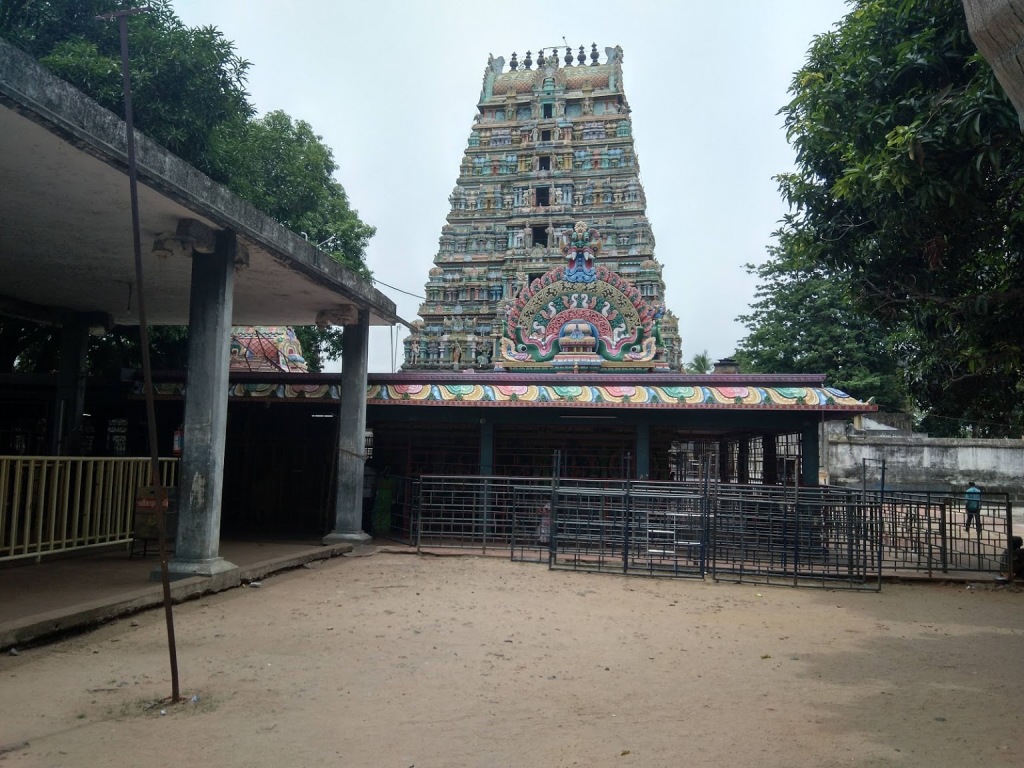
This Temple is facing towards east with seven tiered Rajagopuram. The Rajagopuram is about 85 feet tall. The temple covers an area of about 10 acres with three prakarams. There is a front Mandapam before the Rajagopuram. Stucco images of Rishabaroodar flanked by Vinayaga and Muruga can be seen at the top of the Mandapam. The entire temple complex is enclosed completely within granite walls.


The Temple Complex has three major shrines namely Vakra Kali Amman Shrine, Chandramouleeswarar Shrine and Varadaraja Perumal Shrine. Though the presiding deity is Chandramouleeswarar, Vakra Kali is more famous in this temple complex. Vakra Kali Shrine can be seen immediately after the Rajagopuram. There is a newly built Mandapam connecting the Vakra Kali Shrine with Chandramouleeswarar Shrine.


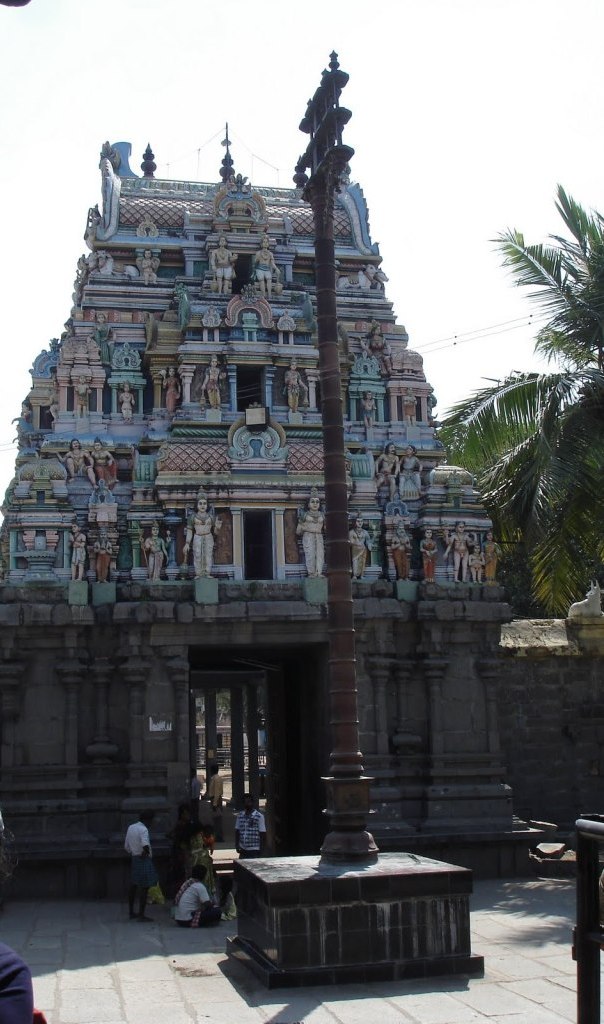
Nandi and Balipeedam can be found in this Mandapam facing the sanctum. Chandramouleeswarar Shrine can be accessed via three tiered Rajagopuram. This gopuram is called as Kandarathithan Thirugopuram / Kili Gopuram. Shrines of Dwara Ganapathy and Murugan can be seen at the entrance of this Rajagopuram on either side. Dhwaja Sthambam can be found immediately after this Rajagopuram facing the sanctum.  


Usually, one can see the main deity from the entrance of the temple itself, however, in this temple the main deity is not visible from the entrance because the Rajagopuram, Dhwaja Sthambam (flag post), Balipeedam, Nandhi and main deity are not in a straight line. Each one of them is slightly away from the other. They are Vakra in nature (contradictory to tradition). Dhwaja Sthambam (flag post) is slightly on the north side.  


Chandramouleeswar Shrine:

For brief details, please refer below link;

https://explore-pondicherry.blogspot.com/2020/09/chandramouleeswar-temple-thiruvakkarai-chandramouleeswarar-shrine.html

Vakra Kali Shrine:

For brief details, please refer below link;

https://explore-pondicherry.blogspot.com/2020/09/chandramouleeswar-temple-thiruvakkarai-vakra-kali-shrine.html

Kanda Lingam Shrine:

For brief details, please refer below link;

https://explore-pondicherry.blogspot.com/2020/09/chandramouleeswar-temple-thiruvakkarai-kanda-lingam-shrine.html

Vasantha Mandapam:

For brief details, please refer below link;

https://explore-pondicherry.blogspot.com/2020/09/chandramouleeswar-temple-thiruvakkarai.html

Deepalaksmi Shrine:

For brief details, please refer below link;

https://explore-pondicherry.blogspot.com/2020/09/chandramouleeswar-temple-thiruvakkarai-deepa-lakshmi-shrine.html

Amirthambigai / Vadivambigai Shrine:

For brief details, please refer below link;

https://explore-pondicherry.blogspot.com/2020/09/chandramouleeswar-temple-thiruvakkarai-amirthambigai-shrine.html

Kundalini Maharishi Samadhi:

For brief details, please refer below link;

https://explore-pondicherry.blogspot.com/2020/09/chandramouleeswar-temple-thiruvakkarai-kundalini-maharishi-samadhi.html

Varadaraja Perumal Shrine:

For brief details, please refer below link;

https://explore-pondicherry.blogspot.com/2020/09/chandramouleeswar-temple-thiruvakkarai-varadaraja-perumal-shrine.html

Sahasra Lingam Shrine:

There is a shrine for Sahasra Linga behind Varadaraja Perumal Shrine. The distinctive feature of this Lingam is that it has 1,008 Lingams carved on the main Lingam.

Navagraha Shrine:

There is a shrine for Navagrahas behind Varadaraja Perumal Shrine. The crow, the vahana of Sani Bhagwan, is facing the left side against the traditional right side. Here Sani is Vakra in nature (contradictory to tradition). Hence, he is called as Vakra Sani. Those facing Vakra Sani period (sometimes planets use to move retrograde called Vakra), pray here for relief from its effects.


Nataraja Shrine:

Nataraja Shrine can be seen at the back side of Chandramouleeswarar Shrine. He is found dancing the Vasantha Thandava where his left leg is placed on the ground and his right leg is lifted up against the tradition of his right leg placed on the ground and left leg lifted up. His hair is tied up and not flowing as depicted in other temples. Here, Nataraja is Vakra in nature (contradictory to tradition).

Murugan Shrine:

There is a shrine for Lord Murugan in the temple premises. He is gracing the devotees with twelve hands seated on Peacock along with his consorts Valli and Devasena. Saint Arunagirinathar had praised Lord Murugan of this temple in his Thirupugazh hymns.

Sapta Matrikas Shrine:

Idols of Saptha Matrikas namely Varahi, Indrani, Kaumari, Vaishnavi, Brahmini, Maheshwari and Chamundi can be seen inside the temple premises. This shrine can be seen immediately after the second level Rajagopuram on the left side. It is said that Vakra Kali Amman herself present here in the form of Chamundi. These idols are dated to Pallavas based on the architectural style.


Other Shrines:

Shrines and Idols of Bikshadana, Lingodbhava, Arthanareeswarar, Nagas, Bhairava, Kala Bhairava,  Agasthya Lingam, Shodasa Lingam (Lingam with 16 stripes), Vinayaga under a tree, another Vinayaga with 2.5 feet tall Mushika, and Nalvar can be seen in the temple premises.


Theerthams:

Theerthams associated with this temple are Surya Pushkarini, Chandra Pushkarini and Varaha River. The temple tank is located adjacent to the temple.


Sthala Vriksham:

Sthala Vriksham is Vilvam Tree.


Chandramouleeswar Temple, Thiruvakkarai – Varadaraja Perumal Shrine

Chandramouleeswar Temple, Thiruvakkarai – Varadaraja Perumal Shrine

Varadaraja Perumal Shrine is located behind the Chandramouleeswar shrine in the temple premises. This Shrine is facing towards west. The idol of Lord Varadaraja Perumal is about six feet tall. He is in standing posture without his consorts. Lord Varadaraja Perumal is having the Chakra in prayoga form (ready to be hurled). 


This posture is Vakra in nature (contradictory to tradition). Garudazhwar and Hanuman can be seen facing Varadaraja Perumal. There is a unique stone carving called Ramakrishna can be seen on the inner wall opposite to Varadaraja Perumal. Lord Krishna is seen with Bhama and Rukmini holding a flute in his right hand and bow in his left hand. 


Chandramouleeswar Temple, Thiruvakkarai – Kundalini Maharishi Samadhi

Chandramouleeswar Temple, Thiruvakkarai – Kundalini Maharishi Samadhi

Kundalini Maharishi Samadhi is situated to the right side of Chandramouleeswarar Shrine in the temple premises. A Shiva Lingam is installed over his Samadhi. This Shrine is facing towards east. This Shrine consists of a Mukha Mandapam and Sanctum. The Sanctum is guarded by huge Dvarapalas. Dakshinamoorthy and Vishnu are the Koshta idols located around the walls of this Shrine.


Chandramouleeswar Temple, Thiruvakkarai – Amirthambigai Shrine

Chandramouleeswar Temple, Thiruvakkarai – Amirthambigai Shrine

Mother is called as Amirthambigai / Vadivambigai. She is housed in a separate south facing shrine in the temple premises. Her shrine is situated immediately after the second level Rajagopuram on the right side. Her shrine consists of Ardha Mandapam and Sanctum. She is in standing posture and is about 5 feet tall.


Chandramouleeswar Temple, Thiruvakkarai – Deepa Lakshmi Shrine

Chandramouleeswar Temple, Thiruvakkarai – Deepa Lakshmi Shrine

Deepa Lakshmi Shrine is situated opposite to Vasantha Mandapam in the temple premises. Unmarried Girls light lamps in lemon peel and tie yellow threads to the goddess on full moon days. It is a belief that if they do this ritual, they will be blessed with good bridegroom. There are several Naga idols near her shrine. People pray here to get rid of Naga Doshams.